The questions to ask about the current migrant influx at the southern border:
Where are the majority of the migrants coming from? Mexico, Central America, Cuba, Hatti et al?
What business interests do US businesses and corporations have in each country? NAFTA, CAFTA-Hatti, other private companies?
Who profits and who loses from US companies moving factories or doing manufacturing in foreign nations?
How much foreign aid does the US Government send to each of these countries involved?
How much in remittances does each of these countries receive from its migrants who live and work in the US?
How much US political influence do US corporations have in each of these foreign countries? How much influence do they have in Washington politics?
How much do US businesses in the US rely upon migrant labor (legal or illegal) from these foreign countries?
How much money does the US Border Industrial Complex make trying to "control" the Border (especially those companies who have detention facilities in the US)?
Just pretend that there is corruption in the US politics and in all countries' governments involved. Deep pockets are being filled by the US immigration system "failing" as it does. How many decades has each political party screamed for immigration reform with little if anything ever being done? Yet each party eventually ends up being in power.
Did it ever occur to you that this failed system is by design? Again, who profits and who suffers from this designed to fail system?
Every US or foreign politician involved who does not address the issues above is cementing the status quo: foreign migrants suffering in their own countries while US taxpayers foot the bills and cough up the profit for those who maintain this US immigration status quo/nightmare/scam.
And what do US voters do? They believe the immigration propaganda from each of their respective political parties while not having enough sense or taking the time to see who is being screwed here.
Why doesn't the US Government do more to work directly with the governments of the migrants' countries to help alleviate the migration problem? I say the elite who run all governments involved (including the US Border Industrial Complex) profit because of the status quo: more and more migrants come to the US, more and more remittances sent back to the migrants' countries, more and more political profit gained for US political parties, more and more profits for all corporations who provide equipment and technology to US Customs and Border enforcement and more and more profits to all those involved in the smuggling of migrants, illegal drugs, weapons and illegal cash from one country to another.
Add whoops and hollers about a busload of migrants from this Texas political stunt showing up on the VP's doorstep. This keeps the ignorant, deceived and dumb dumbed down.
We have met the enemy Pogo. And the enemy is (those of) us (who allow this to go on). those
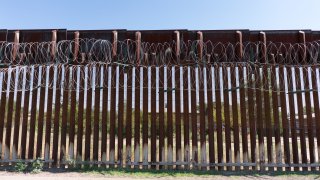
A portion of the U.S.-Mexico border wall in Douglas, Arizona.
Authorities are investigating the cause of death this week of a
Mexican woman whose leg was entrapped while using a climbing harness and
ended up hanging upside down off the border wall in eastern Arizona.
U.S. Customs and Border Protection officials offered few details, but
the local sheriff’s office said the woman was a 32-year-old who was
attempting to cross the wall Monday night near Douglas, Arizona. Her
name was not released.
Dear World - United In Total Self-Awakening or Total Self-Destruction?
There are only two ways this ego
driven, unconscious culture (and world) will be united - through spiritual awakening
(consciousness) or by total self-destruction.
The fact that the majority of Americans think
that one political side or the other can unite us or that the American
Government and US Military can save us does not bode well for the consciousness
side of the two choices equation.
It’s
up to each of us as individuals to cast our own fate or faith if you like.
"Two Pesos Pobres" is a song that I wrote and dedicated to the undocumented farm workers from Mexico who put their lives on the line and food on American tables every day.
Here is a video of Jen's and my performance at the AFOP (Association of Farmworker Opportunity Programs ) conference in New Orleans, 12/2010.
Sorry about the apparent extra step: cut and paste https://www.youtube.com/watch?v=nKj8fBdB4Oo or https://www.youtube.com/results?search_query=new+orleans+afop+conference+2010.
Lyrics:
Campesinos Mexicanos, will you survive? Pobreza, corrupcion y narco - violencia
Its harder and harder to cross the line, Will you get through or will you die tryin'
Y los Americanos ellos no comprenden
Hopelessly poor, in a desperate land, houses of pallets, they do what they can Campesinos Mexicanos, they farm to survive, necessitan trabajo, without it they'll die
Sin
papeles legales, they run for their lives, cosechas Americanas, al Norte they arrive, los niños se lloran, ¿'apa, adonde vas? Their
families are starving, what is the cost?
They are Two Pesos Pobres, y más peor, South of the border they struggle for more, Two Pesos Pobres, y más peor, Que Dios les ayude, as you go north
Los ricos, el gobierno, they have way to much, Carteles, y drogas, its best not to touch, They see poor mamá, without papá, asi es la vida, que sera sera
They are Two Pesos Pobre, y mas peor, South of the border they struggle for more, Two Pesos Pobres, y mas peor, Que Dios les ayude, as you go north
They love this new country, they love USA, they start their new families, aquí they will stay Por favor, please forgive them for crossing you line, they seek a new future aquí on your side
They are Two Pesos Pobres, y más peor, South of the border they struggle for more, Two Pesos Pobres, y más peor, Grácias a Dios, el Norte's your home
As a retired US Border Patrol/ICE agent (26 years) I say this immigration article by Lois Beckett in "The Guardian" is one of the most accurate and truthful articles I have ever read concerning illegal immigration.
You won't hear much about the points made in this article in American news or politics. Why? Washington is not interested in Americans knowing the truth, especially about illegal immigration. Many, many political careers have been made off of the Republican's rhetoric of "build a wall, boot 'em out" to the Democratic rhetoric "let 'em have a chance".
Yet despite all of the back in forth propaganda I have seen in my sixteen years of retirement and twenty-six years of service, very little if anything actually changes when it come to illegal immigration.
Sure, amnesty and DACA here, border wall and immigration surges there - but overall, the pattern remains the same. US corporations profit off of the system remaining the same. There is profit to be made off of illegal labor. There is profit to be made off of whole border enforcement industrial complex that never quite gets the job done. Just like the "war on drugs" no?
Interview
‘A system of global apartheid’: author Harsha Walia on why the border crisis is a myth
The Canadian organizer says the actual crises are capitalism, war and the climate emergency, which drive mass migration
The rising number of migrant children and families
seeking to cross the US border with Mexico is emerging as one of the
most serious political challenges for Joe Biden’s new administration.
That’s
exactly what Donald Trump wants: he and other Republicans believe that
Americans’ concerns about a supposed “border crisis” will help
Republicans win back political power.
But
Harsha Walia, the author of two books about border politics, argues
that there is no “border crisis,” in the United States or anywhere else.
Instead, there are the “actual crises” that drive mass migration – such
as capitalism, war and the climate emergency – and “imagined crises” at
political borders, which are used to justify further border
securitization and violence.
Walia, a Canadian organizer who helped found No One Is Illegal, which advocates for migrants, refugees and undocumented people, talked to the Guardian aboutBorder and Rule, her
new book on global migration, border politics and the rise of what she
calls “racist nationalism.” The conversation has been edited for length
and clarity.
Last month, a young white
gunman was charged with murdering eight people, most of them Asian
women, at several spas around Atlanta, Georgia. Around the same time,
there was increasing political attention to the higher numbers of
migrants and refugees showing up at the US-Mexico border. Do you see any connection between these different events?
I think they are deeply connected. The newest
invocation of a “border surge” and a “border crisis” is again creating
the spectre of immigrants and refugees “taking over.” Thisseemingly race neutral language – we are toldthere’s nothing inherently racist about saying “border surge”– is actuallydeeply
racially coded. It invokes a flood of black and brown people taking
over a so-called white man’s country. That is the basis of historic
immigrant exclusion, both anti-Asian exclusion in the 19th century,
which very explicitly excluded Chinese laborers and especially Chinese
women presumed to be sex workers, and anti-Latinx exclusion. If we were
to think about one situation as anti-Asian racism and one as anti-Latinx
racism, they might seem disconnected. But both forms of racism are
fundamentally anti-immigrant. Racial violence is connected to the idea
of who belongs and who doesn’t. Whose humanity is questioned in a moment
of crisis. Who is scapegoated in a moment of crisis.
How
do you understand the rise of white supremacist violence, particularly
anti-immigrant and anti-Muslim violence, that we are seeing around the
world?
The rise in white supremacy is a
feedback loop between individual rightwing vigilantes and state
rhetoric and state policy. When it comes to the Georgia shootings, we
can’t ignore the fact that the criminalization of sex work makes sex
workers targets. It’s not sex work itself, it’s the social condition of
criminalization that creates that vulnerability. It’s similar to the
ways in which border vigilantes have targeted immigrants: the Minutemen who show up at the border and harass migrants, or the kidnapping of migrants
by the United Constitutional Patriots at gunpoint. We can’t dissociate
that kind of violence from state policies that vilify migrants and
refugees, or newspapers that continue to use the word “illegal alien”.
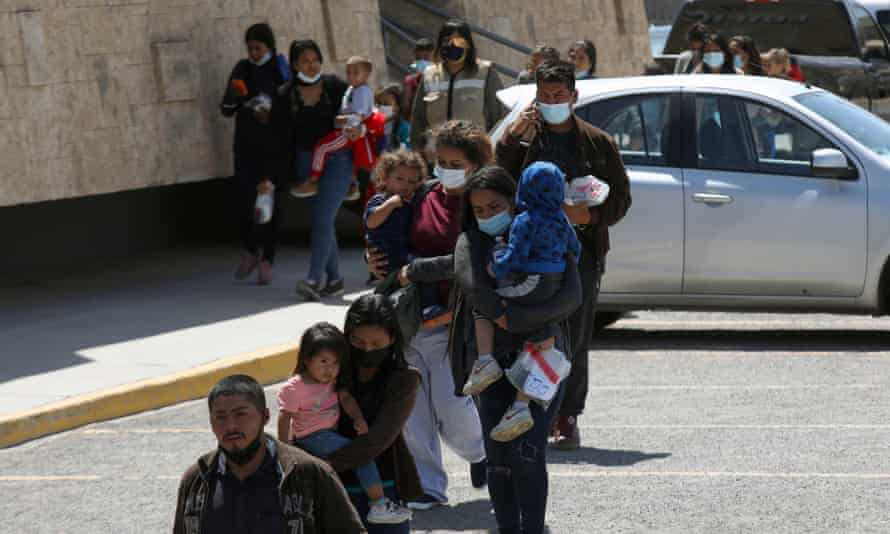
Central
American migrants expelled from the US under Title 42 at the National
Migration Institute station in Ciudad Juarez, Mexico. Photograph: Hérika Martínez/AFP/Getty Images
National
borders are often described as protecting citizens, or as protecting
workers at home from lower-paid workers in other countries. You argue
that borders actually serve a very different purpose.
Borders
maintain a massive system of global apartheid. They are preventing, on a
scale we’ve never seen before, the free movement of people who are
trying to search for a better life.
There’s
been a lot of emphasis on the ways in which Donald Trump was enacting
very exclusionary immigration policies. But border securitization and
border controls have been bipartisan practices in the United States. We
saw the first policies of militarization at the border with Mexico under
Bill Clinton in the late 90s.
In the European
context, the death of [three-year-old Syrian toddler] Alan Kurdi, all of
these images of migrants drowning in the Mediterranean, didn’t actually
lead to an immigration policy that was more welcoming. Billions of
euros are going to drones in the Mediterranean, war ships in the
Mediterranean. We’re seeing the EU making trade and aid agreements it
has with countries in the Sahel region of Africa and the Middle East
contingent on migration control. They are relying on countries in the
global south as the frontiers of border militarization. All of this is
really a crisis of immobility. The whole world is increasingly becoming
fortified.
What are the root causes of these ‘migration crises’? Why is this happening?
What we need to understand is that migration is a form of reparations. Migration
is an accounting for global violence. It’s not a coincidence that the
vast number of people who are migrants and refugees in the world today
are black and brown people from poor countries that have been made poor
because of centuries of imperialism, of empire, of exploitation and
deliberate underdevelopment. It’s those same fault lines of plunder
around the world that are the fault lines of migration. More and more
people are being forced out of their land because of trade agreements,
mining extraction, deforestation, climate change. Iraq and Afghanistan
have been for decades on the top of the UN list for displaced people and
that has been linked to the US and Nato’s occupations of those
countries.
Why would governments have any interest in violence at borders? Why spend so much money on security and militarization?
The
border does not only serve to exclude immigrants and refugees, but also
to create conditions of hyper exploitation, where some immigrants and
refugees do enter, but in a situation of extreme precarity. If you’re
undocumented, you will work for less than minimum wage. If you attempt
to unionize, you will face the threat of deportation. You will not feel
you can access public services, or in some cases you will be denied
public services. Borders maintain racial citizenship and create a pool
of hyper-exploitable cheapened labor. People who are never a full part
of the community, always living in fear, constantly on guard.
Why do you choose to put your focus on governments and their policies, rather than narratives of migrants themselves?
Border
deaths are presented as passive occurrences, as if people just happen
to die, as if there’s something inherently dangerous about being on the
move, which we know is not the case. Many people move with immense
privilege, even luxury. It’s more accurate to call what is happening to
migrants and refugees around the world as border killings. People are
being killed by policies that are intended to kill. Literally,
governments are hoping people will die, are deliberating creating
conditions of death, in order to create deterrence.
It
is very important to hold the states accountable, instead of narratives
where migrants are blamed for their own deaths: ‘They knew it was going
to be dangerous, why did they move?’ Which to me mimics the very
horrible tropes ofsurvivors in rape culture.
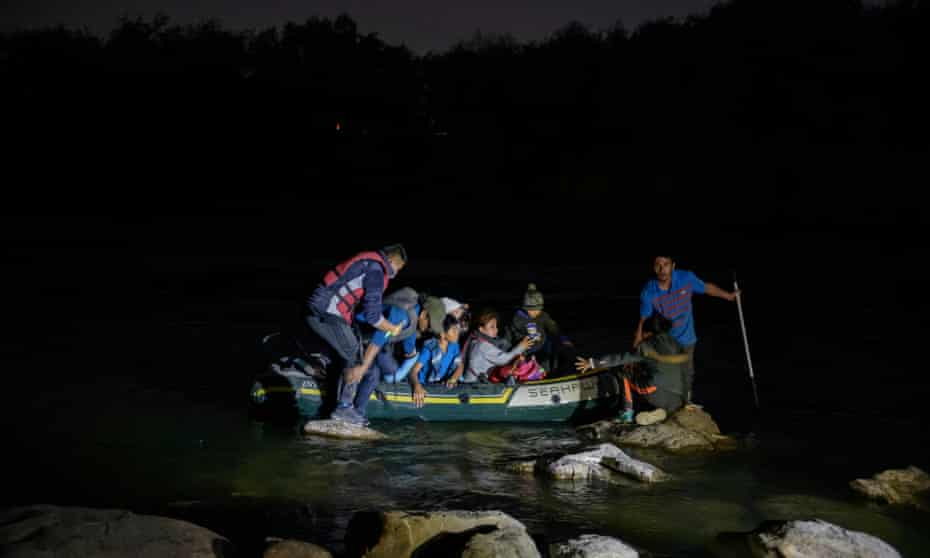
Oscar,
an unaccompanied Guatemalan child migrant, crosses the Rio Grande river
from Mexico on an inflatable boat, before turning himself over to US
border patrol agents. Photograph: Ed Jones/AFP
You live in Canada. Especially in the United States, many people think of Canada as this inherently nice place. Less racist, less violent, more supportive of refugees and immigrants. Is that the reality?
It’s
totally false. Part of the incentive of writing this second book was
being on a book tour in the US and constantly hearing, ‘At least in
Canada it can’t be as bad as in the US.’ ‘Your prime minister says
refugees are welcome.’ That masks the violence of how unfree the
conditions of migration are, with the temporary foreign worker program,
which is a form of indentureship. Workers are forced to live in the
home of their employer, if you’re a domestic worker, or forced to live
in a labor camp, crammed with hundreds of people. When your labor is no
longer needed, you’re deported, often with your wages unpaid. There is
nothing nice about it. It just means Canada has perfected a model of
exploitation. The US and other countries in Europe are increasingly
looking to this model, because it works perfectly to serve both the
state and capital interests. Capital wants cheapened labor and the state
doesn’t want people with full citizenship rights.
Advertisement
You wrote recently that ‘Escalating white supremacy cannot be dealt with through anti-terror or hate crime laws.’ Why?
Terrorism
is not a colorblind phenomena. The global war on terror for the past 20
years was predicated around deeply Islamophobic rhetoric that has had
devastating impact on Black and Brown Muslims and Muslim-majority
countries around the world. I think it is implausible and naive to
assume that the national security infrastructure, or the criminal legal
system, which is also built on racialized logics, especially anti-black
racism – that we can somehow subvert these systems to protect racialized
communities. It’s not going to work.
One of the things that happened when the Proud Boys were designated as a terrorist organization in Canada
is that it provided cover to expand this terror list that communities
have been fighting against for decades. On the day the Proud Boys were
listed, a number of other organizations were added which were part of
the Muslim community. That was the concern that many of us had: will
this just become an excuse to expand the terrorist list rather than
dismantle it? In the long run, what’s going to happen? Even if in some
miraculous world the Proud Boys and its members are dismantled, what’s
going to happen to all the other organizations on the list? They’re
still being criminalized, they’re still being terrorized, they’re still
being surveilled.
So if you don’t think
the logics of national security or criminal justice will work, what do
you think should be done about escalating white supremacist violence?
I
think that’s the question: what do we need to be doing? It’s not about
one arm of the state, it’s about all of us. What’s happening in our
neighborhoods, in our school systems, in the media? There’s not one
simple fix. We need to keep each other safe. We need to make sure we’re
intervening whenever we see racial violence, everything from not letting
racist jokes off the hook to fighting for systemic change. Anti-war
work is racial justice work. Anti-capitalist work is racial justice
work.
You advocate for ending border
imperialism, and ending racial capitalism. Those are big goals. How do
you break that down into things that one person can actually do?
I
actually found it harder before, because I would try things that I
thought were simple and would change the world, and they wouldn’t. For
me, understanding how violences are connected, and really understanding
the immensity of the problem, was less overwhelming. It motivated me to
think in bigger ways, to organize with other people. To understand this
is fundamentally about radical, massive collective action. It can’t rely
on one person or even one place.
... we have a small favour to ask. You’ve read
in the last year. And you’re not alone; through these turbulent and
challenging times, millions rely on the Guardian for independent
journalism that stands for truth and integrity. Readers chose to support
us financially more than 1.5 million times in 2020, joining existing
supporters in 180 countries.
With
your help, we will continue to provide high-impact reporting that can
counter misinformation and offer an authoritative, trustworthy source of
news for everyone. With no shareholders or billionaire owner, we set
our own agenda and provide truth-seeking journalism that’s free from
commercial and political influence. When it’s never mattered more, we
can investigate and challenge without fear or favour.
Unlike
many others, we have maintained our choice: to keep Guardian journalism
open for all readers, regardless of where they live or what they can
afford to pay. We do this because we believe in information equality,
where everyone deserves to read accurate news and thoughtful analysis.
Greater numbers of people are staying well-informed on world events, and
being inspired to take meaningful action.
We
aim to offer readers a comprehensive, international perspective on
critical events shaping our world – from the Black Lives Matter
movement, to the new American administration, Brexit, and the world's
slow emergence from a global pandemic. We are committed to upholding our
reputation for urgent, powerful reporting on the climate emergency, and
made the decision to reject advertising from fossil fuel companies,
divest from the oil and gas industries, and set a course to achieve net
zero emissions by 2030.
If
there were ever a time to join us, it is now. Every contribution,
however big or small, powers our journalism and helps sustain our
future.Support the Guardian from as little as $1 – and it only takes a minute. Thank you.


.png)
.png)


.png)